
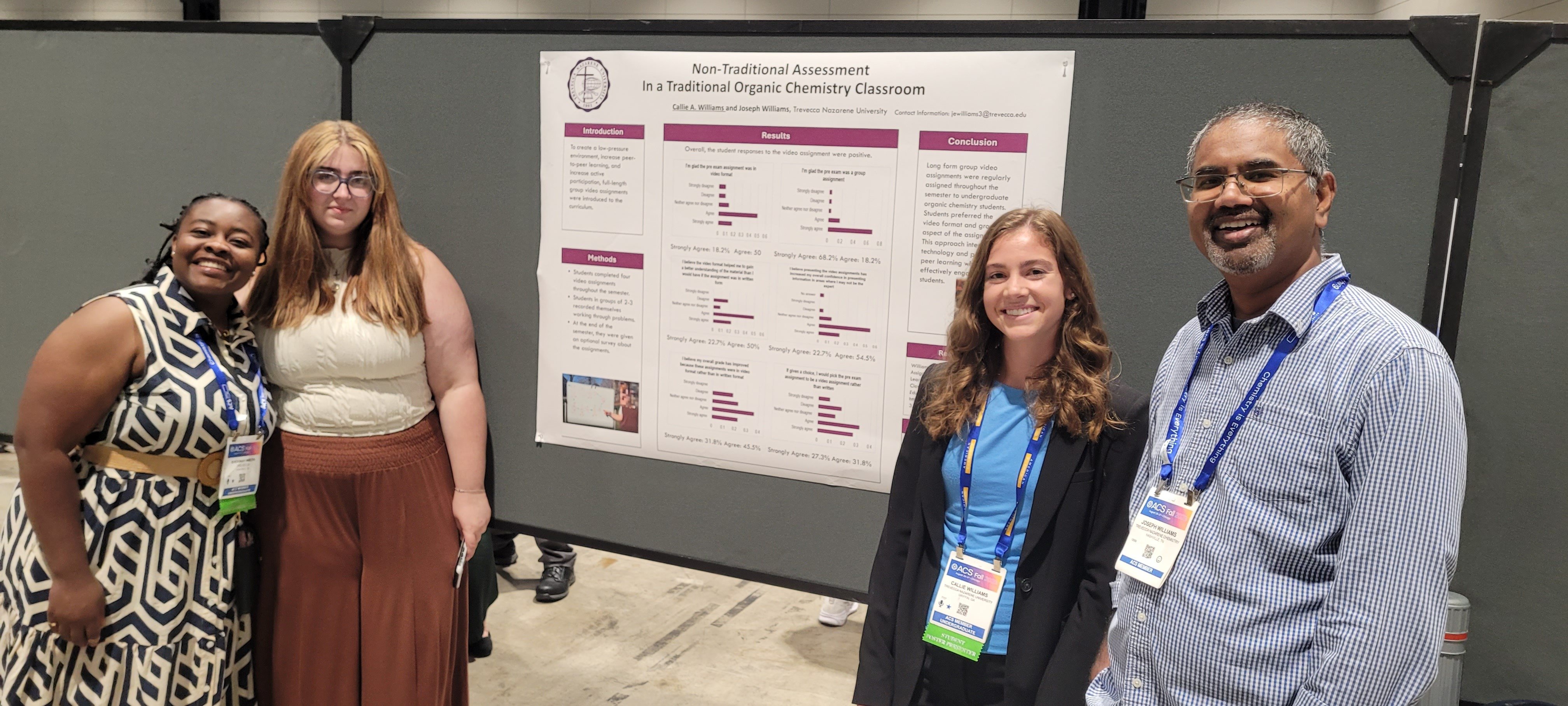
For Trevecca students Shekinah Mbepa and Callie Williams, a few big questions about chemistry went from class projects to published research. Their presentations were selected for the American Chemical Society fall 2026 meeting in Chicago as they represented Trevecca among researchers from across the world.
The American Chemical Society (ACS) is one of the world’s leading organizations for chemistry professionals. Its national meetings bring together students, faculty and researchers from the United States and abroad to present work across chemistry and related fields.
Mbepa and Williams each presented research developed under the mentorship of chemistry professor Dr. Joseph Williams, in Trevecca’s School of STEM.
For both students, the road to ACS began long before they arrived in Chicago.
Shekinah Mbepa
 “Introducing Drug Docking as a Lab Project in the Organic Chemistry Curriculum”
Mbepa, a biology major with a chemistry minor on a pre-med track, came to Trevecca from Zambia in spring 2023. Long before she arrived in Nashville, she dreamed of becoming a doctor. But for much of her life, that future felt far away.
Before coming to the United States, Mbepa said at one point she and her mother lived in a thatched house while her father was battling cancer. She was also selling chickens to help make ends meet.
“One night I was looking down at the sunset thinking, ‘Is this really all that I can do with my life,’” Mbepa recalled. “I said, ‘Lord, I want to be a doctor.’”
Mbepa said the opportunity to study in the United States came after her uncle offered to invest in her education. She applied to a few universities, but the connection she felt with Trevecca stood out.
“I got into Trevecca and I felt this peace reading my acceptance letter,” Mbepa said. “I saw that the Lord was leading me to Trevecca.”
She’s found a second home on the Hill.
“Coming to Trevecca is a miracle and a blessing for me,” Mbepa said. “I have been blessed every single year by the faculty, the staff, everybody.”
One of those faculty members has been Dr. Joseph Williams.
In Williams’ organic chemistry class, Mbepa was introduced to a drug-docking project designed to help students see how organic chemistry connects to the process of developing medication. The project allowed students to choose a disease, select a common drug used to treat it and use software to visualize how the drug interacts with a protein.
Mbepa worked on the project with McKenna Smith, who also contributed to the published research but was unable to attend the ACS meeting. Their work focused on chemistry education, helping students understand how concepts from organic chemistry can connect to real research.
“In a way, it’s an introduction to the world of research,” she said.
The project eventually moved beyond the classroom. Mbepa and Smith worked with Joseph Williams to turn the project into a peer-reviewed article published in “The Chemical Educator.” From there, Mbepa submitted an abstract to the American Chemical Society and was accepted to present their research at the ACS meeting in Chicago.
Callie Williams
 “Non-Traditional Assessment in a Traditional Organic Chemistry Classroom”
Callie Williams came to Trevecca from Griffin, Georgia, as a three-sport high school athlete. She was first drawn to Trevecca through softball.
She played softball for three years at Trevecca and is now making the switch to track and field, where she plans to throw javelin.
“I have absolutely loved my time doing softball here,” Williams said. “I really just wanted to switch it up and see if I could be successful somewhere else too.”
Williams is a chemistry major with minors in math and economics. This fall, she plans to begin applying to Ph.D. programs in chemistry, with an interest in organic or environmental chemistry, with one main desire. “I really want to go into research,” she said.
Her ACS presentation also began with an organic chemistry experience under the tutelage of Dr. Joseph Williams.
Callie began by reviewing existing scientific literature to see if anyone had already done similar work. From there, she helped develop an abstract, collect data, write a manuscript and submit the work for peer review.
The project studied whether video assignments could help students feel more confident working through exam-style problems.
Students worked in small groups, solved organic chemistry problems and recorded themselves explaining how they reached their answers. The goal was to make the course more approachable while helping students practice communicating information they were still learning.
“What we found was that students really liked it,” she said. “The students had a lot of fun with it.”
The research was later published in “The Chemical Educator,” giving Williams an early look at the process of scientific publication. “It was really validating that it actually got published,” Williams said.
After many late nights spent working on the project outside of class, publication gave Williams a funny kind of payoff: telling friends who had no idea what she had been working on.
“I was doing this project on the side, so no one really knew about it,” Williams said. “And then like one day I’ll just be like, guys, I got published. And they’re like, what are you talking about?”
Peer reviewers checked references and offered critiques before the paper could be accepted.
“It is very humbling to get that back because you poured your heart and soul into this,” Williams said.
The experience confirmed Williams’s interest in research and gave her a clearer picture of the work she hopes to pursue.
“Being able to work through that process this early and with someone like Dr. Williams, whom I trust, was honestly a really good experience for me,” she said.
Presenting at ACS
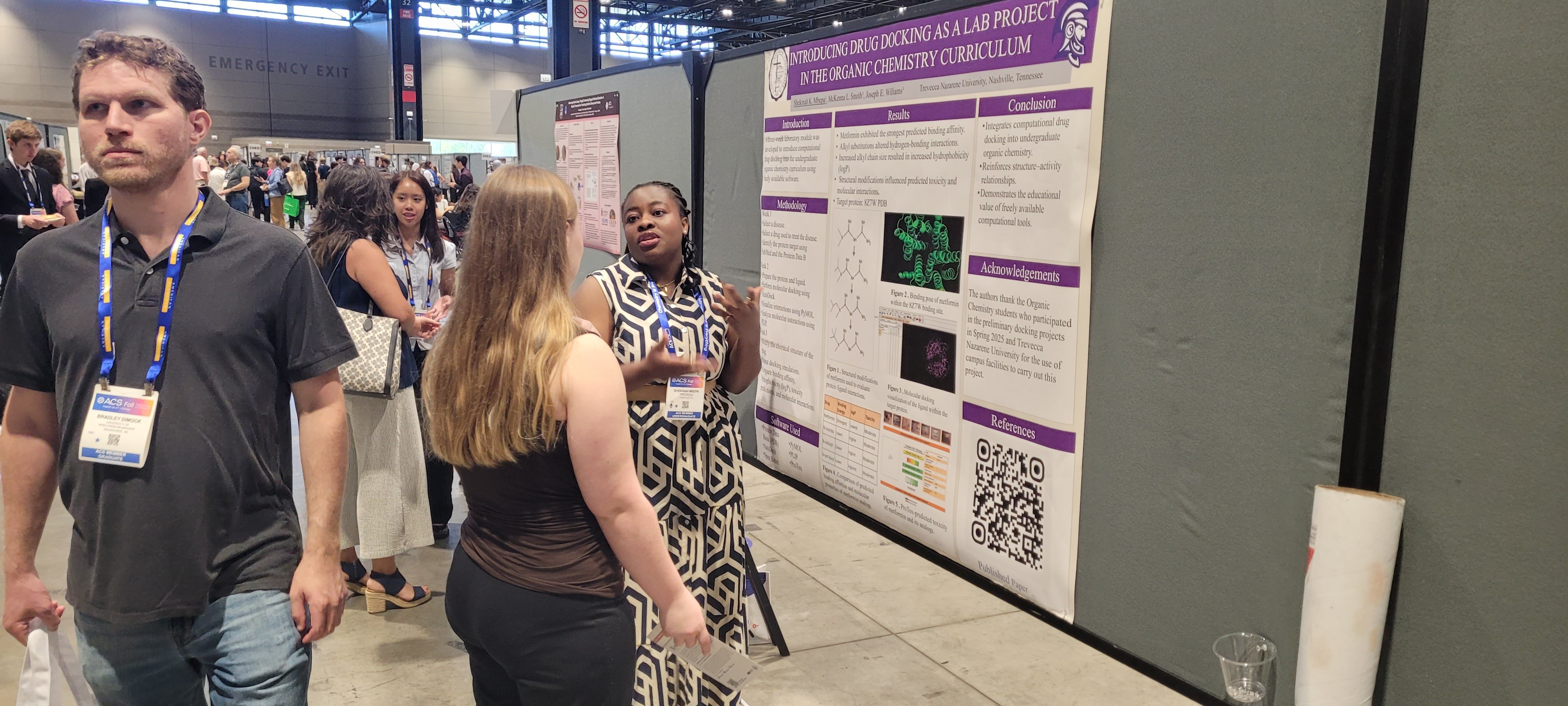
After their research was published, Mbepa and Williams were encouraged to submit abstracts to ACS. Both were accepted to present at the ACS Fall 2026 meeting in Chicago at McCormick Place.
Mbepa described the conference as much larger than she expected. “It felt more global than national,” she said.
Mbepa said the meeting gave students a chance to see research from across the world and learn more about what graduate school and scientific research can look like.
“It’s a huge chemistry convention where you get to see some of the most brilliant minds in the world do what they do best,” Mbepa said.
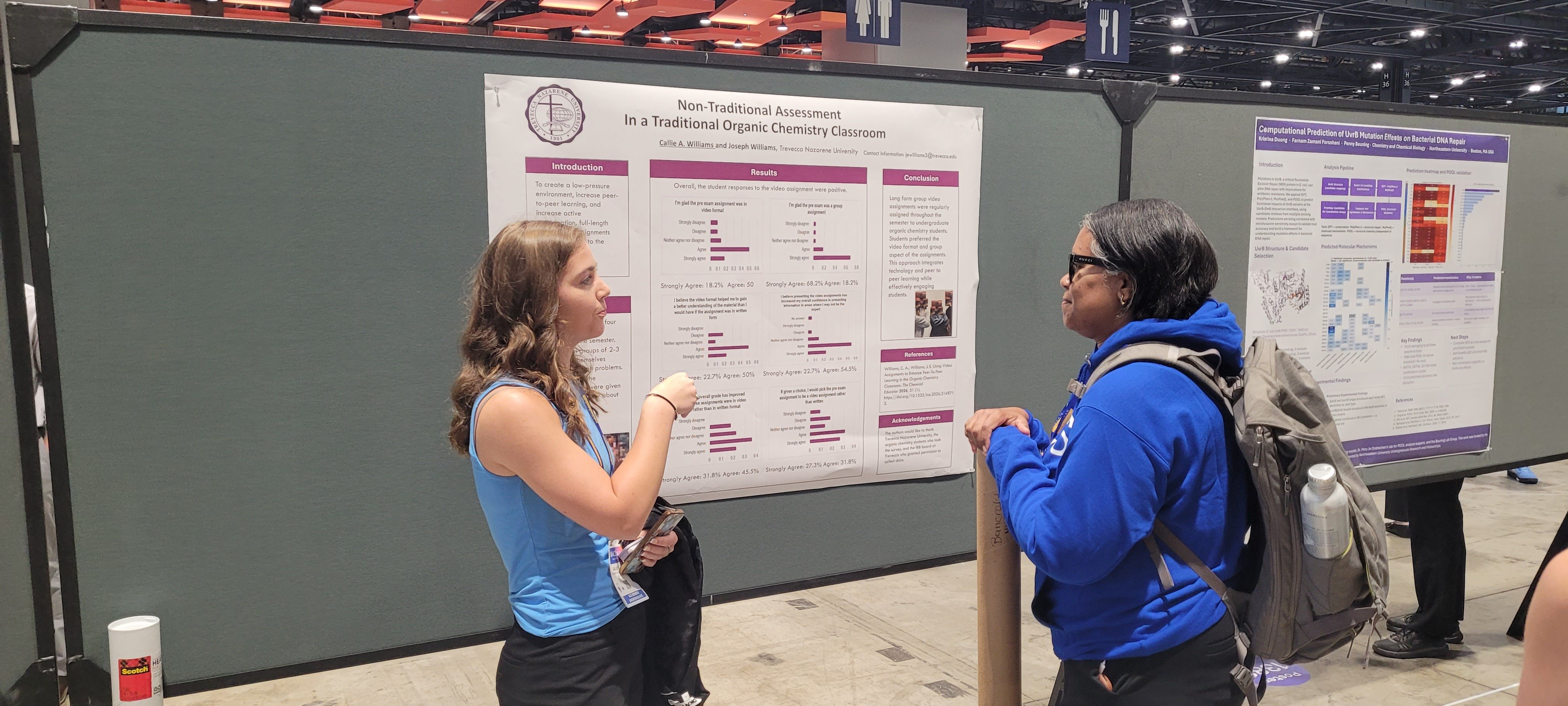
Williams described the undergraduate poster session in simpler terms.
“It’s kind of a really fancy science fair,” Williams said.
At a poster session, presenters stand with their research posters while attendees walk around, ask questions and talk with them about their projects.
Williams’ poster was also selected for Sci-Mix, a secondary presentation opportunity at ACS. According to ACS, presentation in Sci-Mix is considered a distinction because selected posters represent some of the best science and presentation work from each participating division.
For Williams, that meant presenting her work in a setting that included undergraduate students, graduate students, postdoctoral researchers and faculty members.
“You really had a mix of everybody presenting,” Williams said.
Help From Faculty
Organic chemistry, according to Callie Williams, is known for being difficult. As a student-athlete, she often missed Friday classes during softball season and spent significant time in Joseph Williams’ office asking questions.
“Doctor Williams, I don’t understand,” she remembered saying.
He kept helping. “He never got annoyed at my questions. And there were a lot of questions,” Williams said.
While ACS gave Mbepa and Williams a larger platform for their work, both students point back to their professor’s mentorship as central to the experience.
“Dr. Williams truly was a blessing to us throughout the entire process,” Mbepa said. “He believed in us when we sometimes did not believe in ourselves and encouraged us to take a chance and pursue opportunities we may not have thought were possible.”
Callie Williams said Trevecca professors have made difficult goals feel possible, whether through research opportunities, teaching experience or simple willingness to help students figure out what comes next.
“They are all just so willing to help, which is not something most people get,” she said. “This is a hard thing to do and they make it feel so attainable.”
Future Prospects
For Mbepa, the next step is medical school. She recently took the MCAT and is waiting on her scores, as she hopes to become a doctor.
“As a future doctor, I will firstly be in a position of leadership, but also in a position of servanthood,” Mbepa said. “I want to be at a point financially where I’m able to give back as much as possible to open up opportunities for other students.”
Williams is preparing to apply to chemistry Ph.D. programs this fall. Her goal is to continue into research and eventually lead research of her own.
Both students left Chicago with published work, a national presentation experience and the confidence that their research belonged in the room.
And for both, that confidence began at Trevecca.