

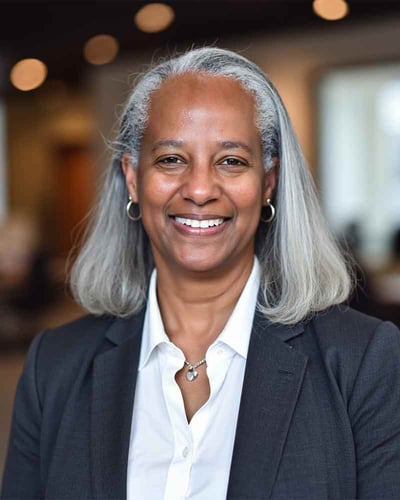
 The path from a promising molecule to an FDA-approved drug is complex, and the process itself is not always inclusive. For Ph.D. candidate Savine DaCosta, addressing that reality is central to her work in clinical research.
As a clinical trial access and representation site lead at Biogen, DaCosta operates at the intersection of cutting edge science and trust-building. She works to ensure all people are empowered to explore their options for health and healing. Currently, most participants for drug trials are caucasian males, limiting the research that’s done on how some drugs may impact individuals from other populations.
“When we look at clinical research, we have an underrepresentation of African American, Hispanic and Asian Pacific populations, as well as certain age groups,” DaCosta said. “Some of the work I do is with community engagement, educating individuals on their own diseases and meeting people where they are to understand what clinical research is and how it can help them before a drug even gets to the market.”
Her work spans a variety of drug trials and conditions, from Alzheimer’s and Lupus to very rare diseases, where her team endeavors to support individuals in their health journey as they fight to preserve and improve their quality of life.
This dedication to inclusion led her to Trevecca, where she began her Ph.D. in leadership in August 2025 at the suggestion of a colleague. DaCosta and her colleague both started the program together, and they’ve appreciated its focus on empowerment and self-awareness.
As the mother of a son with multiple disabilities, her understanding has been shaped, in part, by navigating a world that is not always designed for accessibility.
The empathy and advocacy she has cultivated has become a starting point for her research. DaCosta will graduate in 2028, but her dissertation is already taking shape, merging her life and leadership experience with a commitment to changing communities.
“A lot of things are designed for able-bodied people and people that don't have disabilities. So I'm focused on using authentic leadership, critical disability theory, psychological safety and intersectionality to create a model around how we can design purposely for inclusion,” DaCosta said. “I want to bring some of that research to the surface to show people how this can be so much better.”
DaCosta recalls the ongoing conversations she has had on behalf of her son, calling places in advance to ask about their accessibility.
“My son's wheelchair weighs 450 pounds. So I need to know, for instance, if there's a step in front of the building. Do I need to bring a manual chair? Can he be in his electronic wheelchair? It's been interesting doing the research because I live that life with my son,” DaCosta said.
In addition to her personal connection as a leader and parent, she has also valued “hearing the voices of scholars,” as she puts it, building her skills in the Ph.D. program to compile existing research, understand industry standards and settle into an approach to accessibility that is both expansive and evidence-based.
As she looks toward graduation a few years down the road, DaCosta remains open to all the possibilities for the future, whether applying her growing expertise at Biogen or consulting for special-needs communities. What is certain is that she is determined to bridge the gap between clinical research and healthcare that accounts for the experiences of all populations.
“My passion is to empower patients to make appropriate decisions about their own healthcare,” DaCosta said. “I’ve been in this industry for a long time, and as a product of an underrepresented community, I want to take my learning and help those communities see things from a different lens.”